Australian ammonia imports log most competitive prices ever
Sekisui proposes World Expo 2025 exhibitors to test PSC cells
Itochu, Emirates produce to work on a sustainable aluminum
JPX to restart carbon credit market trading in October
JFE Engineering to test CO2 capture facility for incinerators
JAPEX, JOGMEC and Pertamina to study CCUS at oil field
Mitsui and Taiyo Oil to conduct study on production of SAF
ELECTRICITY MARKETS
Baseload market to add 2-year contracts from August
Chubu Grid to launch Japan’s first drone power line monitoring
Trading report shows sales down for new energy providers
Kansai Electric restarts Unit 1 at Takahama nuclear plant
Tokyo Gas will build LNG-fired power station in Chiba
Tokai invests in the Philippines for hydro power development
JERA completes purchase of Belgium’s top offshore wind player
Tohoku Electric begins summer electricity-saving campaign
OIL, GAS & MINING
Middle East keeps high oil import share despite output cuts
LNG stocks fall to 1.98 million tons, lowest in 15 months
LNG imports from Brunei, Indonesia slump; U.S. surges
INPEX signs MoU on collaboration with PT Pertamina
ANALYSIS
MUNICIPALITIES SEE MORE CONTROL OVER RENEWABLES PROJECTS; THE MIYAGI TAX ISSUE
Miyagi Prefecture in northeast Japan has an area of 7,300 square kilometers, close to the size of Cyprus. It was an early mover in the renewables space, attracting the fourth largest Feed-in-Tariff capacities in 2014. Yet, a decade later, it has unveiled plans to install a new levy that would effectively tax every one in five yen earned by some solar and wind operators. The stance by local governments seems at odds with the national goals to double Japan’s renewables capacity this decade. However, when Japan NRG spoke with local officials, they said that their motivations are misunderstood.
AS AGRISOLAR DRAWS INTEREST, INACTIVE SOLAR TARIFF HOLDERS GET WEEDED OUT
As Japan continues to make strides in its transition to renewable energy, solar power stands out as a significant contributor, outpacing all other green sources. However, even as the country aims to achieve its ambitious target of raising the renewables share in its power mix to 36-38% by 2030, peculiar challenges in the solar sector have emerged. Slow progress in some projects has prompted the government to take action. With over 8.9 GW of certified capacity still unused, METI is starting to revoke licenses for projects that have not met promised deadlines to ensure that the solar sector operates more efficiently.
New Energy and Industrial Technology Development Organization
kWh
Kilowatt hours (electricity generation volume)
TEPCO
Tokyo Electric Power Company
FIT
Feed-in Tariff
KEPCO
Kansai Electric Power Company
FIP
Feed-in Premium
EPCO
Electric Power Company
SAF
Sustainable Aviation Fuel
JCC
Japan Crude Cocktail
NPP
Nuclear power plant
JKM
Japan Korea Market, the Platt’s LNG benchmark
JOGMEC
Japan Organization for Metals and Energy Security
CCUS
Carbon Capture, Utilization and Storage
OCCTO
Organization for Cross-regional Coordination of Transmission Operators
NRA
Nuclear Regulation Authority
GX
Green Transformation
NEWS: ENERGY TRANSITION & POLICY
METI policy panel to draft new plan in power auction system to finance NPPs
(Government statement, July 26)
A METI sub-panel on basic power and gas policies will draft a new plan to finance nuclear power plants by using a long-term decarbonization power auction system.
NPPs need investment to improve safety; the power auction system can help them to boost profits on their investment into nuclear safety units, as stated in the Decarbonization Power Supply Act.
The panel also identified facility upgrades for hydrogen/ammonia/ biomass co-firing at thermal plants as projects that would be financed under the power auction system.
The first long-term decarbonization power auction will be held in Jan 2024.
TAKEAWAY: See the analysis: Overview of the Long-Term Decarbonized Capacity Auction in the Jan 23, 2023 issue of Japan NRG.
METI, JFTC in talks to ease antitrust rules on green business projects
(Japan NRG, July 27)
METI and the Japan Fair Trade Commission began discussions to ease antitrust regulations on collaborations for net zero initiatives, said Yoshimura Katsumoto, METI director of Material Industries Division. He spoke at Techno Frontier in Tokyo.
In March, the JFTC published Green Competition Guidelines to clarify net zero collaborations that would be non-compliant with the Anti-Monopoly Act.
“Companies, when on their own, are able to speed up research, but when they collaborate the projects stop because they can’t share information,” Yoshimura said. METI proposes to ease rules on information sharing to spur initiatives to speed up decarbonization.
JERA launches $300 mln VC fund for energy and tech startups
(Company statement, July 24)
JERA has launched its VC fund, JERA Ventures.
Through 2030, JERA Ventures plans to invest $300 million in startups focusing on energy and other sectors or other funds that have connections to promising companies.
Prime targets are energy businesses that are building up value chains for hydrogen and ammonia, LNG, and renewable energy initiatives. JERA is ready to help with a proof-of-concept, demo or testing at its own facilities.
In addition to energy, the fund will target investments in digital tech such as AI and blockchain.
MHI to lead high-temp gas reactor demo, expand hydrogen power supply
(Company statement, July 25)
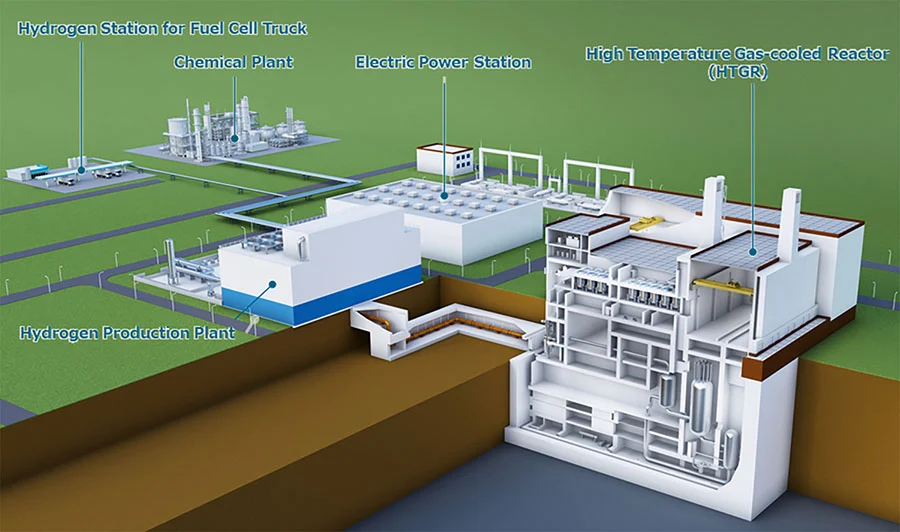
METI’s energy agency, ANRE, selected MHI to lead the next-gen nuclear project based around high temperature gas-cooled reactors (HTGR).
MHI will be in charge of coordinating the R&D, design, and construction of a HTGR demonstration reactor that the govt wants to be in operation during the 2030s.
CONTEXT: HTGRs are capable of supplying carbon free heat at extremely high temperatures exceeding 900°C, which makes them suitable as a power source for electrolysis for creating hydrogen. MHI has been involved in HTGR tech since the 1970s.
MHI wants the reactor development to include a facility to produce hydrogen. It targets 900°C with a thermal output of 600 MW for the nuclear reactor.
TAKEAWAY: This is a project that is more about hydrogen than nuclear. Since the hydrogen manufacturing process would not create emissions, and could be done on a mass scale, Mitsubishi has designs on offering it to a number of industrial sectors such as steelmaking to help them move to cleaner processes. It may also be marketed as fuel for hydrogen power generation, feedstock for chemical products and fuel cell trucks.
Source: MHI
JAPEX, JOGMEC and Pertamina sign CCUS joint study agreement
(Company statement, July 26)
JAPEX, JOGMEC and two Pertamina companies signed an agreement to test carbon injection at the Sukowati oil field, exploring the Indonesian site’s potential for carbon storage.
They will test the Huff & Puff method to inject carbon, and explore impact on enhanced oil recovery and carbon storage.
TAKEAWAY: Japan has identified Malaysia and Indonesia as potential CCS hubs and partners in the technology. This marks the identification of one of the first practical sites for the carbon injections and will be a project worth monitoring going forward.
ENEOS accelerates hydrogen development for carbon reduction goals
(S&P Global, July 21)
Sunaga Kotaro, the senior vice president of ENEOS, discussed the company’s plans to develop hydrogen supply chains and reduce its carbon intensity by 2040.
The company is investing in CO2-free hydrogen projects in several countries and aims to supply 4 million tons/ year of hydrogen by 2040. ENEOS also plans to produce SAF and explore carbon capture and storage solutions.
The goal is for carbon neutrality in Scope 1 and Scope 2 emissions by 2040. To offset remaining emissions, they’ll use CCS and carbon credits from forestry projects.
Australian ammonia imports log their most competitive ever in H1 2023
(Japan NRG, July 28)
Ammonia imports from Australia, averaging at ¥62,215/ ton, were the most competitive in the January to June period, according to customs data. The figures are for ammonia for fuel specifications.
Imports from Indonesia averaged at ¥89,186/ ton, Saudi Arabia ¥266,769/ ton, and Taiwan ¥644,719/ ton.
Japan imported 105,015 tons of ammonia for a total value of ¥8.8 million in the first half of the year.
During the period, Japan exported 50 tons to China, Taiwan, Singapore and the U.S. for ¥58 million, or ¥1.2 million/ ton.
Sekisui proposes World Expo 2025 exhibitors to test PSC cells
(Japan NRG, July 25)
Sekisui Chemicals will install prototypes of perovskite solar cell (PSC) at the World Expo 2025 site in Osaka, and will provide the modules to the other Expo participants interested in testing the new tech.
It is likely to offer the same prototype it has provided, or plans to provide, to JERA, the Tokyo Metropolitan govt, NTT Data and JR East. The company plans to commercialize the product in 2025.
CONTEXT: PSC is a next-gen solar cell tech made with thin perovskite-structured layers, instead of silicon to generate power. The World Expo will be the first exposure of the Japanese PSC tech to the international audience.
TAKEAWAY: The govt restricts Japanese PSC players to engage with foreign counterparts, and will possibly prohibit production of PSC systems overseas as well, in a bid to protect the tech, according to a METI official. However, installing PSC systems on exhibition booths will not result in technology breaches.
Itochu and Emirates Global Aluminium to work on a sustainable aluminum supply
(Company statement, July 21)
Itochu and Emirates Global Aluminium (EGA) signed an MoU at the UAE-Japan Business Forum.
The MoU focuses on aluminum production growth and ensuring a sustainable aluminum supply to the global market, as well as decarbonization efforts.
Itochu has a long history of selling high-value-added aluminum products made by EGA to customers in Japan, Asia, North America, and Europe.
CONTEXT: EGA uses LNG to generate electricity required for aluminum production, but plans to shift to nuclear, solar and hydrogen-derived power. It also produces its own alumina feedstock, made from caustic soda, likely produced at fossil-fuel powered plants, and bauxite ore.
TAKEAWAY: The extent is unclear of the aluminum supply chain that the companies plan to decarbonize — from bauxite mining to aluminum billets, foundry alloys and slabs – or further downstream. Many Japanese business leaders flew with PM Kishida and participated in the UAE-Japan Business Forum to understand the UAE’s potential to deliver cheap green hydrogen. If the UAE produces the world’s cheapest hydrogen, many Japanese companies would happily move their downstream manufacturing operations there.
JPX to restart carbon credit trading in October
(Company statement, July 26)
JPX officially announced the opening of a carbon credit market in October, which would restart the trading that was trialed in a limited mode last year.
This will further contribute to developing a carbon pricing system in Japan.
Until now, the trading of J-credits has been conducted through either negotiated transactions or bidding and selling by the govt. But with the opening of the TSE Carbon Credit Market, trading on the exchange will become possible.
Market Outline
Sales classification:
The sale targets J-CREDITS, classified into 6 types according to credit’s application (renewable energy-electricity, renewable energy-heat, energy conservation etc)
Nominal unit price
¥1
Sales unit
1t-CO2
Price fluctuation limit
Multiplication by 90% of the base price
Base price
1. same price as stipulated in the previous trading session
2. same base price as the previous trading session
Order type
Limit orders only
Source: JPX data
Shizen Energy to launch Shizen Connect to expand its energy business
(Company statement, July 25)
In October, Shizen Energy will launch Shizen Connect, a 100% subsidiary to offer a virtual power plant (VPP) service integrating controls of storage batteries, EVs, and EV chargers. The goal is a sales turnover of ¥10 billion by 2030.
Since 2018, Shizen Energy has been developing an energy management system, “Shizen Connect”, collectively controlling renewable energy power generation equipment, storage batteries, EVs, and other energy resources using IoT and AI.
Considering the importance of the VPP service in the coming decade, Shizen Connect will accelerate development of the service and strengthen its partnerships with electric retailers and power generation equipment manufacturers.
SIDE DEVELOPMENT: Shizen Connect adopted by Tokyo Gas EV service planner (Company statement, July 24)
Shizen Connect, an energy management service, has been chosen by Tokyo Gas for its “Charge Planner” EV introduction support service to remotely measure electricity.
The Planner requires measuring how much electricity is consumed for charging EVs in order to manage the cost of electricity.
Shizen Connect will offer an app to measure the amount of electricity required along with customer needs and provide the data to the Charge Planner.
JFE Engineering to test CO2 capture facility for incinerators
(Company statement, July 24)
JFE Engineering is conducting a demo test for a CO2 capture facility targeting medium-sized factories and waste incineration facilities.
Called “GX-Marble,” the facility aims to capture between 3 and 100 tons a day and achieve a CO2 capture rate of 99.5%.
The system combines membrane separation and physical adsorption methods for CO2 recovery. The company plans to offer the equipment in 40-foot containers.
The test will run from October 2023 to September 2024. If successful, sales would start by mid FY2024.
Hitachi Zosen inaugurates CO2 liquefaction facility in Switzerland
(Company Statement, July 24)
The CO2 liquefaction facility in Nesselnbach, Switzerland was opened by Regionalwerke AG Baden and Recycling Energie. The facility was developed by Hitachi Zosen Inova.
The plant converts CO2 from biogas upgrading into a valuable resource. Previously, this CO2 was released into the environment during gas refinement. Now, it is purified, filtered, and liquefied at the facility by cooling it. The liquefied CO2 is then compressed into tanks for storage and transport.
The project builds on a biogas plant operated by Recycling Energie AG, which refines raw gas into biomethane – a natural gas substitute used in heat and power generation.
Chiyoda won a FEED contract from Sekisui Chemical for a plant to transform CO2 to CO
(Company statement, July 21)
Chiyoda was awarded a front end engineering design (FEED) contract from Sekisui Chemical for a plant in Osaka to chemically transform CO2 to CO (carbon monoxide) that will be applied in a pre-treatment process for supplying bioreactors.
This project is part of NEDO’s Green Innovation Fund, covering the “Promotion of Carbon Recycling Using CO2 from bio-manufacturing technology as a Direct Raw Material”; the technology aims to transform more than 90% of CO2 into CO using “chemical looping technology.”
Japan Oxygen Holdings supplies oxygen for DAC in the U.S.
(Denki Shimbun, July 24)
Japan Oxygen Holdings will supply oxygen to a Direct Air Capture (DAC) plant under construction by Matson TriGas, a U.S. company.
The DAC plant captures CO2 from the atmosphere. Matson TriGas will use a potassium hydroxide solution to absorb CO2 from the air and further process it to extract concentrated CO2.
The plant starts operations in the mid-2020s, aiming to capture about 500,000 tons of CO2 annually.
Mitsui and Taiyo Oil to conduct study on production of SAF
(Company statement, July 26)
Mitsui and Taiyo Oil will study the production of sustainable aviation fuel (SAF) and renewable diesel (RD), planning to establish a supply chain for SAF and RD.
The collaboration will leverage American LanzaJet’s Alcohol-to-Jet (ATJ) technology, Taiyo Oil’s plant operating expertise, and Mitsui’s ethanol feedstock procurement capabilities. The goal is to begin production in FY2028, producing up to 220,000 kiloliters of Japanese-made SAF/ RD annually.
SAF will be used as aviation fuel, while RD will be suitable for buses, trucks, and other transportation means that use light diesel oil. The initiative was selected in April for the Okinawa Clean Energy Introduction Promotion Research Program.
CONTEXT: The ATJ technology utilizes a catalytic reaction to produce SAF and RD from alcohol (ethanol) and has obtained certification for aircraft use according to the necessary ASTM (American Society for Testing and Materials) standards.
SIDE DEVELOPMENT: KCPC launches new distillation unit to help produce zero-carbon SAF (Company statement, July 12)
Bioethanol is a raw material to produce sustainable aviation fuels (SAF). Kimura Chemical Plants (KCPC) launched a new energy-saving, heat-pump type bioethanol distillation unit that enables zero CO2 emission in the production of SAF.
When producing SAF by the alcohol-to-jet (ATJ) process, bioethanol (the raw material) needs to be distilled or concentrated to increase its energy density. Traditionally, this required boiler steam that emits a lot of CO2.
With this new equipment, bioethanol is distilled by renewable power, without using boiler steam. Then the heat pump recovers low-temperature heat, reusing it as energy.
Air Water will use LBM to fuel small satellite launch rockets
(Company statement, July 21)
Air Water and Interstellar Technologies adopted liquefied bio-methane (LBM) made from livestock manure from Hokkaido to fuel the small satellite launch rocket, Zero. This fall, the companies will test the fuel at Hokkaido Space Port (HOSPO).
Air Water Group is setting up a local supply chain in Hokkaido to collect livestock manure and produce biogas, then convert it to LBM. Air Water Hokkaido partners with Interstellar Technologies through its space development program, supplying both technologies and materials such as LNG and fuel tanks.
At the end of June, Air Water was successful in using LBM for marine fuel.
EVs become heavier as more steel parts are used
(Japan NRG, July 26)
EV models released in the last two years have become heavier since their structural components and body parts are now made of steel, instead of aluminum and resin, according to Nikkei BP Consulting analyst Kariatuma Koji. Aluminum was used extensively in previous models to reduce car weight; but the metal was used only for chassis in the most recent models from Tesla, BYD, Volkswagen and Nissan.
Kariatsuma noted that automakers are integrating onboard chargers and electronic control units with other components and trying new approaches to cool batteries. He spoke at the Techno-Frontier 2023 event in Tokyo.
TAKEAWAY: EVs have been going through a cycle: battery raw material prices rise, less-expensive steel parts are used, cars become heavy and battery performances decline, and then cars become lighter by replacing heavy parts with parts made with lighter materials such as aluminum, resin and plastics. The need to be lightweight will likely be highlighted again despite new features to improve battery performances, as recent models are mounted with cameras and entertainment systems. Meanwhile, the trend to integrate different component units may create new challenges for recycling car parts.
NGK secures order for NAS batteries from Hungary
(Company statement, July 24)
NGK Insulators received an order for NAS electricity storage batteries from the Center for Energy Research of Hungary through Duna Center Therm Uzemi Szolgaltato, a Hungarian engineering company.
The NAS battery (250 kW DC output) will be used in a demo at the Center for Energy Research in Budapest to evaluate large stationary storage batteries for stabilizing renewable energy.
Komatsu launches 20-ton excavator equipped with Li-ion battery
(Company statement, July 21)
Komatsu unveiled a new 20-ton excavator equipped with Lithium-ion batteries. Starting October, the model will be rolled out in Japan and European markets for leasing, and then in Asia, North America, and Australia.
Since 2021, Komatsu has been developing these models with Proterra, a U.S. lithium-ion battery provider.
Idemitsu cancels biomass venture with Swiss TG2
(Company statement, July 25)
Idemitsu Kosan canceled a planned partnership with Swiss-based TG2 group to produce biomass pellets from empty fruit bunches in Malaysia. No reason was given but the company continues to study production of EFB-derived fuel in Malaysia.
The companies had planned to launch a 120,000 tons/ year biomass pellet plant in Kuantan in Q4 of 2023.
Omron and Waseda Univ to develop factory energy management system
(Company statement, July 20)
Omron and Waseda University will start an R&D project for a factory energy management system. The project was selected for funding by the Cabinet Office.
The R&D period will be from FY2023 to FY2027. In general, manufacturing has high energy consumption, but lacks standardized energy management systems, data formats and communication standards for electricity.
Omron will develop production models that optimize a factory’s productivity, quality, and energy, and also design and implement interfaces to connect factories by utilizing sensing, data analysis, and control technology.
Waseda U will configure a virtual environment and large-scale optimization infrastructure for linking factory energy management systems.
NEWS: POWER MARKETS
Baseload market to add 2-year contracts starting August
(Denki Shimbun, July 24)
Regulations for the baseload (BL) market will face changes starting this fiscal year, including the addition of long-term contracts with a 2-year delivery period and the introduction of a fuel cost adjustment scheme for agreed prices.
The effectiveness of the new rules will be tested in this August’s auctions.
BL market rules face revision for the first time since opening in 2019. Along with existing 1-year contracts, 2-year contracts will be introduced to meet the needs of both sellers and buyers.
The extended delivery period will involve a fuel adjustment system for all 2-year contracts. While 1-year contracts will be traded at fixed prices, the 3rd auction will include the fuel cost adjustment scheme. Specific supply obligations will be set for power generation companies.
CONTEXT: There are discussions for a possible abolition of the BL market in the future, in light of the need for an effective wholesale market. Although concerns were raised about the need for reevaluation, the BL market will continue for now, with the goal of increasing liquidity and improving the efficiency of power access.
Balancing market to add new products, EPRX holds explanation session
(Denki Shimbun, July 24)
The Electric Power Supply and Demand Regulation Exchange (EPRX) held an online system briefing for its members in anticipation of the launch of all products in the supply and demand adjustment market in FY2024.
In addition to a one-month test to be conducted from February 2024 to ensure smooth implementation, the schedule for the system switchover was also explained.
The supply/demand adjustment market will begin trading in April 2024 for the primary adjustment, secondary (1), and secondary (2) commodities. The three additional commodities and Tier 3 (1) will be traded on a weekly basis. Participants will need to switch to the Web API.
An inbound test and operational test to confirm that the new system can transfer data correctly will be conducted for all products from February 5 to March 5, 2024.
Chubu Grid to launch Japan’s first drone power line monitoring service
(Japan NRG, July 26)
Next year, Chubu Electric Power Grid plans to launch power line and tower surveillance services with drones, which may be the country’s first. Presently, the company offers inspection services to non-power customers.
Last year, the company held pilot tests of such inspections that were expanded to Okinawa and Shikoku, which have different power line specifications.
The company also plans to use the drones to monitor high-rise power towers in mountains and wind farm installations, in addition to facilities in flat areas.
CONTEXT: Japan lags behind the U.S. and China, where drone-based power line inspections are widely used. The country’s drone service market is ¥178.4 billion, accounting for 4% of the global market. While the energy sector accounts for 14% of global drone-based services, Japan has not yet seen a commercial launch. Non-energy infrastructure monitoring, farming and geological surveys are major applications.
TAKEAWAY: Drone inspection services are expected to significantly cut the cost of power network surveillance. Grids hire helicopters for remote area inspections. It costs ¥2 million for one helicopter flight. A state project to ramp up nationwide power networks to transmit renewable power to cities, as well as increases in offshore wind power stations, will create a strong demand for drones. Grids and renewable operators which have tested the drones for in-house use are expected to make entries into this market, as well as providers of 3-D map and data analysis tools.
Trading report shows sales down for new electricity providers
(Denki Shimbun, July 25)
According to a trading report by the Electricity and Gas Trading Surveillance Committee, overall sales of electricity in April decreased by 9% YoY; while in the same period the sales of shin denryoku, the new market entrants since liberalization, were down 27.2% YoY.
This decline marks the seventh consecutive month of double-digit decreases in sales for new energy providers.
In April, the market share of new electricity providers accounted for 15.9%, a decrease or four percentage points.
Kansai Electric restarts Unit 1 at Takahama NPP
(Nikkei, July 28)
Kansai Electric restarted Unit 1 at Takahama NPP after a 12-year shutdown. This is the beginning of long-term operation for Japan’s oldest NPP, in service for 48 years.
A new law allows nuclear reactors to operate beyond 60 years; if Unit 1 operates beyond 60 years, it will be Japan’s first to do so.
Kansai Electric’s financial performance has improved, reporting a record profit due to the decrease in fuel prices and improved operating rates of NPPs. This could lead to price cuts for customers, increasing Kansai Electric’s popularity with the public after recent scandals such as the unauthorized view of consumers’ data.
However, challenges remain, such as managing spent fuel storage capacity. Kansai Electric needs to finalize the location for interim storage of spent fuel by the end of 2023, or its older reactors will need to shut down.
Tokyo Gas will build LNG-fired power station in Chiba
(Company statement, July 21)
Tokyo Gas will build an LNG-fired power generation plant in Sodegaura city, Chiba Pref. It will have 3 units of combined-cycle hydrogen, co-fired gas turbines (650 kW each) to generate a total 1.95 MW.
Operation will be managed by Chiba Sodegaura Power, a 100% subsidiary of Tokyo Gas. A JV of MHI and Mitsubishi Electric will lead construction. First phase starts 2029; full operation by 2030.
Tohoku Electric begins summer electricity-saving campaign
(Nikkei, July 28)
Starting August, Tohoku Electric will begin a summer electricity-saving campaign for households via an app on days when supply and demand are expected to be tight.
Participants will be rewarded with points that can be exchanged for electronic money, based on the amount of electricity saved per hour between 4PM and 8PM.
On days when Tohoku Electric determines that electricity supply will be tight, it will invite households to participate in the electricity-saving effort through the app.
The campaign period runs until late Sept. The August forecasted reserve capacity showing the supply surplus rate within Tohoku Electric’s service area is 7.6%.
JFE Engineering to join grid-scale battery business
(Company statement, July 27)
JFE Engineering will establish J&S Storage Battery in partnership with SDL and JFE Trading to participate in grid-scale battery business, funded by Sustainable Open Innovation Initiative (SII) subsidies.
Later this fiscal year, Kyushu Tech, a JFE Group company, will start installing grid-scale storage batteries in Kumamoto Pref. Urban Energy, a wholly-owned subsidiary of JFE Engineering, will be the operator that uses the batteries once construction is completed starting in Oct 2024.
The companies will levelize renewable energy’s output control to the grid, which often happens in the Kyushu area, and help improve resilience in case of emergency.
Kyushu Electric resumes operations at Nobata Hydropower Station
(Nikkei, July 25)
Kyushu Electric resumed commercial operations at its Nobata Hydroelectric Power Station, (Oita Pref) after 18 months of modernization work.
This included replacement of hydraulic conduits that feed water to the turbines and generators, and reinforcement work on the water discharge channel from the power plant into the river.
Resumption of operations was delayed by four months due to excavation of bedrock and typhoons. Maximum output is 3.8 MW.
The plant began operation in 1936. The annual power output is about 19 GWh.
Tokai invests ¥840 million in Pure Energy, Philippines for hydro power development
(Company statement, July 24)
Tokai, an energy and ICT service company based in Shizuoka, acquired 65 million stocks of Repower Energy Development (REDC), a subsidiary of Pure Energy Holdings, Manila, the Philippines, who operates hydro power stations. This is Tokai’s first project in hydropower overseas. Total investment is ¥840 million.
REDC operates several hydropower stations in the Philippines. With the FIT system, REDC has strong revenue and plans to expand its hydro power business.
JERA completes acquisition of Belgium’s largest offshore wind power company
(Various, July 28)
JERA completed the acquisition of Parkwind NV from Virya Energy, following an initial agreement in March. The purchase indicates an equity valuation of around €1.55 billion.
Parkwind, Belgium’s largest offshore wind company, operates four offshore wind projects with a combined capacity of 771 MW.
Additionally, the recent completion of Arcadis Ost 1 in the Baltic Sea adds another 257 MW. Parkwind’s development pipeline includes over 4.5 GW in capacity.
CONTEXT: JERA has a portfolio of 2 GW in operational renewable capacity and has been actively investing in and developing renewables and offshore wind projects worldwide. Notable examples include the Formosa 2 offshore project in Taiwan and ventures in Japan, including floating wind initiatives.
Hitachi Energy selected to accelerate large-scale renewable integration in Scotland
(Company statement, July 2021)
Hitachi Energy was chosen by SSEN Transmission to supply multiple onshore high-voltage direct current (HVDC) converter stations in Scotland to integrate large-scale renewable power into the UK grid.
It will deploy up to five HVDC “power corridors” with up to 2 GW capacity, enabling transmission of wind power from north Scotland to areas with higher energy demand.
The projects are to be operational in 2030 and could provide renewable electricity for around 10 million homes. The company will supply its voltage source converter (VSC) for efficient long-distance transmission of electricity.
CONTEXT: Hitachi Energy has also been involved in other key HVDC projects in the UK. Additionally, the company recently secured a large-scale agreement with TenneT to supply 12 GW of offshore wind connections in the Netherlands and Germany.
Shizen Energy began environmental assessment for solar project in Iwate
(Company statement, July 21)
Shizen Energy started an environmental assessment for a new solar power station in Ofunato city, Iwate Pref. In 2013, the company was asked to utilize land in the town of Sanriku; the project site was approved in April 2022.
The project consists of two power stations – Ofunato No. 1 and No. 2 solar stations to be built on 96 ha. The total of 76,600 panels will be installed on 20 ha. Generation capacity will be 35 MW, or 35 GWh a year.
The assessment will be conducted from summer 2023 to spring 2025. Project completion date and operation start are not yet known.
Osaka Gas, JA Mitsui Leasing to build 7 agrivoltaic stations
(Company statement, July 27)
Osaka Gas and JA Mitsui Leasing set up a 50:50 JV,“AO Denryoku 1”, which will build 7 solar power stations on farmlands with a total 8.5 MW capacity.
The panels will be installed on farms in Hokkaido, Gifu, Mie and Kyoto Pref that mainly grow livestock feeds. Osaka Gas will purchase all the power generated.
CONTEXT: The project will be partly state subsidized to promotes agrivoltaics to increase farm income while cutting emissions and energy costs. There are over 3,000 agrivoltaic power stations in Japan, mostly capacities of less than 1 MW.
TAKEAWAY: As municipalities tighten regulations on new renewable installations in order to protect forest areas, the new solar frontiers are farmlands, lakes and rivers. But new conflicts have increased. Solar farm owners complained that soil cultivation and other machine work in the area damaged and tarnished the panels, while neighbors refused to change their farming methods. See this week’s Analysis section for a deep dive on the subject.
New solar frontiers
Prefectures with the highest number of
Agrivoltaic stations
Chiba
Floating solar panels
Hyogo
Shizuoka Pref gets first on-site and off-site combined PPA Service
(Company statement, July 25)
Somic Ishikawa and Chubu Electric Miraiz will implement an on-site and off-site combined PPA service using solar power facilities at Somic Ishikawa Toyooka Plant in Shizuoka Pref. This will be the region’s first such combined service.
Since August 2021, Somic Ishikawa has been using about 293 kW of solar-generated electricity through Chubu Electric’s on-site PPA service at the Toyooka Plant. They will expand the on-site PPA service and increase capacity to about 874 kW.
The expanded facility is set to start operating in November, and any surplus electricity beyond the plant’s consumption will be used at Somic Ishikawa’s Tsurumi Plant, based on Chubu Electric Power Miraiz’s off-site PPA service.
The combined on-site/off-site PPA service allows Somic Ishikawa to efficiently use the rooftop space of the Toyooka Plant and fully utilize the generated electricity within the company without waste.
SIDE DEVELOPMENT: Tokyu Land and Sustech to invest in PPA fund (Company statement, July 26)
Tokyu Land and Sustech will establish and invest in a collaborative fund for non-FIT power generation stations. Those non-FIT renewable energy power sources will be managed by Sustech’s distributed electricity operation platform “ELIC”.
The fund aims to invest ¥150 billion in 10 years for equity investment, which will be among Japan’s biggest initiatives. The scope of investment is not limited to solar power, but other renewables as well. The companies will try to expand their plans beyond FIT, and also create and utilize voluntary credits in overseas PPA.
Tokyo High Court holds first session in TEPCO shareholder action over Fukushima
(Asahi Shimbun, July 25)
On July 24, the Tokyo High Court heard arguments in the appeal trial of a lawsuit by 46 TEPCO shareholders against five former management execs.
They seek ¥22 trillion in compensation from TEPCO for the Fukushima accident.
CONTEXT: In the previous ruling, the Tokyo District Court ordered the former execs to pay ¥13 trillion. However, they seek to nullify the first trial, claiming that the accident was unavoidable due to the earthquake surpassing expectations.
Chubu Electric Power plans a 21 MW onshore wind farm in Aichi
(New Energy Business, July 28)
Chubu Electric is working on an environmental assessment for the 21-MW Atsumi #2 wind power projects in Tahara city, Aichi Pref. This is part of its plan to increase renewable energy to 3.2 GW or more by 2030.
The company plans to build 5 units of 4.2 MW-scale wind turbines on 224,000 m2 in Tahara city. Construction starts in Oct 2024; operations start in Dec 2026.
Chubu Electric has been building two 4.2 MW wind turbines on the site of the Atsumi Thermal Power Station. They’ll soon start operation.
SIDE DEVELOPMENT: MoE minister, Kagoshima governor ask JRE to review plan for Kimotsuki wind project (Government statement, July 24)
The MoE minister and the Kagoshima governor have asked Japan Renewable Energy to review its plan for a 43 MW onshore wind farm in Kimotsuki Township.
They urged scaling down the installations to minimize environmental and wildlife impacts.
NEWS: OIL, GAS & MINING
Middle East keeps high oil import share despite output cuts
(Japan NRG, July 28)
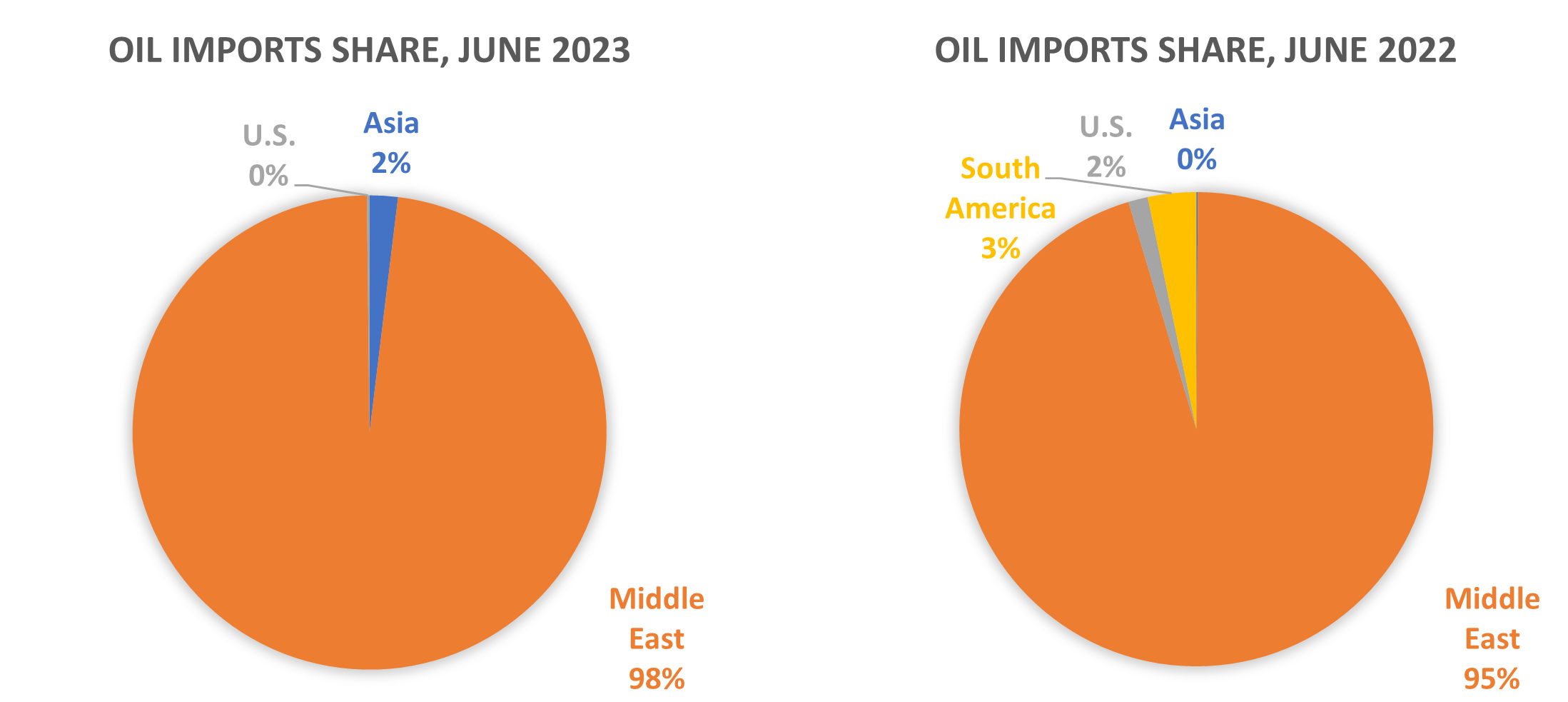
June crude oil imports slumped 14.8% YoY to 10.3 million kiloliters (71 million barrels). Imports from Saudi Arabia, which cut output, were down 11.2%. UAE was down 10.4%. However, the Gulf states took a 98% share of the import volume.
Imports from the U.S. were down 88.6% YoY, but those from Australia and Southeast Asia increased.
Japan imported 85,931 kiloliters (0.5 million barrels) from Indonesia, compared to zero a year ago. The imports from Indonesia were the highest since Feb 2019.
LNG stocks fall to 1.98 million tons, lowest in 15 months
(Government data, July 26)
LNG stocks of 10 power utilities stood at 1.98 million tons as of July 23, down 6.2% from 2.11 million tons a week earlier. The July 16 stocks were first reported at 2.1 million tons but METI corrected the figure.
The stocks were the lowest since the 1.95 million tons on April 24 last year. The end-July stocks last year were 2.28 million tons. The five-year average for this time of year was 2.08 million tons.
TAKEAWAY: Amid scorching summer heat, OCCTO forecasts maximum power demand on the week ending July 28 at 1.52 GW. Power reserve rates are over 8% for all areas meaning there is sufficient supplies at maximum demand.
While LNG stocks slipped, JERA on July 26 reduced by half the run rate of the 1 GW Higashiogishima No. 1 gas-fired power plant due to turbine problems. It will resume normal operations on August 10, according to JERA’s filing to JEPX.
LNG imports from Brunei, Indonesia slump; U.S. surges
(Japan NRG, July 28)
June LNG imports were down 22% YoY to 4.5 million tons. Imports from Brunei fell the most, by 66.2% YoY; followed by Indonesia, down 60.9%, and Oman down 51%.
Imports from the U.S. more than doubled to 5.2 million tons.
Imports from Australia, the biggest supplier, were down 28.6%; and from Malaysia, the second biggest, were down 26.2%.
INPEX signed a MoU with PT Pertamina to develop the Abadi LNG project in Indonesia.
This comes in the wake of Shell’s sale of project stakes to Pertamina and Petronas.
ANALYSIS
BY MAYUMI WATANABE
Municipalities seek more control over renewable energy projects
Last year, a small town in western Japan shocked the renewables industry when it called for a new tax on solar projects calculated on the area that panels occupy. The idea was eventually quashed by the central government. But this year, a new and much larger regional actor has announced similar plans.
Miyagi Prefecture in northeast Japan has an area of 7,300 square kilometers, close to the size of Cyprus. It was an early mover in the renewables space, attracting the fourth largest Feed-in-Tariff capacities in 2014. Yet, a decade later, it has unveiled plans to install a new levy that would effectively tax every one in five yen earned by some solar and wind operators.
The stance by local governments seems at odds with the national goals to double Japan’s renewables capacity this decade to meet CO2 reduction targets. However, the tax plans by the regions reflect their growing concern that a general rush to add more renewables has ignored certain negative impacts on the local environment and society. The most acute today is concern that the clearing of trees for some renewables projects will expose the affected areas to risks of landslides and water shortages.
Miyagi’s tax has yet to receive approval at the national level. But its passage could alter the economics of future projects and entice other regions to add levies on a renewables sector that is already contending with rising costs and lower tariffs. When Japan NRG spoke with local officials, they explained that their motivations are misunderstood.
What happened last summer
Last year, Mimasaka City’s solar tax was a hot topic in energy circles. The city of about 26,000 people proposed a levy based on the area of solar panels. The proposal drew gasps in the renewables community and followed a trend of more and more local authorities passing ordinances to limit construction of new green energy projects.
Mimasaka’s idea, however, did not spread. None of the nearby municipalities joined. In fact, Sayo Township, Mimasaka’s neighbor, told Japan NRG that for decades the town had run a solar power station as an emergency backup resource and they believed that renewables are important. The national government gently deflected Mimasaka’s calls to review its tax idea, urging the city to hold more dialog with renewables operators.
Miyagi’s renewable tax plan is a different story. The proposal is to put a 20% tax on the operating profit of solar, wind and biomass operators that cut down over 0.5 hectares of forest to install the project. The local assembly passed the bill earlier this month. And Miyagi’s neighbors have been supportive of the cause to conserve forest resources from developments.
Miyagi has also walked back some of its initial fire, suggesting that the tax could be lifted for operators that create projects within specified Renewables Promotion Zones or those recognized by local stakeholders as “collaborative” developers. The prefecture is now taking feedback on its proposals.
The Japan Wind Power Association slammed the tax for potentially deterring wind development and hindering national climate targets. However, municipality taxes require approval from the Ministry of Internal Affairs and Communications, which could foil Miyagi’s plans as it did with Mimasaka City; though the prefecture is a bigger player. In showing flexibility of application, Miyagi may also convince the ministry that it will achieve “collaborative engagement” with developers.
Roots of the anti-wind movement
The huge irony is that local resistance to energy projects was something once solely reserved for nuclear power plants. But since last year’s energy crisis, the public acceptance of nuclear power has been rising fast. So where did this newfound resistance to renewable energy come from?
Visiting Kawasaki Township in Miyagi Prefecture feels like going back 50 years in time – there’s no rooftop solar panels on houses nor office flats. The only PV is outside the town office, powering a display with information on radioactivity levels.
Kawasaki lies around 100 kilometers northwest of the Fukushima nuclear power plant. It’s in the heart of the Zao mountain range and daylight hours are short. The town is not ideal for solar power but many developers saw a high potential in wind power. Kansai Electric (KEPCO) was one of them.
Contrary to media reports about KEPCO’s “arrogant push” to install 23 wind stations totaling 96 MW, Kawasaki township officials said the company had been in close communication with locals. “Town meetings were held, although they were under no legal obligation to do so for a plant of their size,” said one official, specifying that while KEPCO followed the right procedures, the plan itself was “wrong”.
In July 2022, the power utility scrapped the wind project plan after environmental impact assessments that followed on the back of a strong opposition from Kawasaki residents, the town authority, the Miyagi governor and the Yamagata governor. The move spread like wildfire, impacting the mood around large solar installations in the Zao area, and wind installations in Kami, Naruko, and other townships in Miyagi.
A Kawasaki official who had served as a direct interface with KEPCO said the leading concern was tearing down the mountain façade, which could cause landslides.
This fear was not unfounded. From April to 2021-February 2022, there were 33 solar power plants that reported landslide-triggered incidents to METI. Later, the ministry conducted on-site inspections of 280 solar power stations suspected of exposure to landslide risk, and it plans to make inspections annually. The high risk areas were concentrated in Hiroshima, Yamaguchi and Shimane Pref in west Japan.
In many cases, the risk arose because developers were only able to secure land with forest cover and needed to clear it to site the equipment. Or, it was the cheaper option.
Regulation through tax
In the case of Kawasaki Township, officials decided that a new tax would be effective in deterring further deforestation. On July 4, the local assembly passed the tax bill, saying a 20% rate would reflect the disciplinary purpose of the measure.
The levy is officially called a Tax to Promote Co-Habitation of Renewables and Communities. If the Ministry of Internal Affairs and Communications gives approval then it will take effect in April 2024. However, contrary to its name, the tax is powerful enough to kill projects. A 1 MW solar station typically requires over 0.5 hectares.
The Miyagi official estimates that 40-100 projects under construction will be subject to the new tax. Smaller solar projects comprise the majority of those numbers, but in terms of capacity onshore wind will face the bigger impact.
Project owners include local farmers converting idle property to solar power stations. Many lack manpower to look after their land and keep away herds of wild monkeys and boars that damage crops. To accommodate such cases, Miyagi Prefecture plans a new category of “project operators that have won community consensus”. These will be exempt from the tax.
The Miyagi official said despite broad media coverage, many operators found out about the tax for the first time only recently. But he stressed: “We want to block deforestation, not renewable development.”
Ripple effects
Despite the good intentions, Miyagi’s example could spur more local tax proposals elsewhere. Policies in the name of forest protection have done well over the years. In 2002, Kochi Prefecture started the country’s first forest tax levied on residents. The system spread to over 30 prefectures, and was recently embraced by the national government. From April 2024, Japan will levy forest taxes on all individual taxpayers.
From March this year, Kawasaki Township also requires operators with over 1 MW of generation capacity to take out three types of damage insurance to ensure victims of landslide incidents can be fully compensated.
For now, this has played out as a regional drama, albeit with national consequences. But it may yet come knocking on the doorsteps in Tokyo.
Many of the bigger renewables projects in the regions, including offshore wind farms, are built with the goal of sending their electricity to the big cities, including the Tokyo Metropolitan area. The distributed power system will require many new power lines and other grid facilities to run through natural terrain. A quarter of Miyagi Prefecture, for example, is designated as national park land.
Building new power transmission networks will mean cutting down lots of trees, says one contractor that works on renewables projects in the regions. Once this element is factored in, power users in cities might be asked to make their own contribution to forestry and water conservation.
Fair or not, regulatory and tax pressure on renewables seem to be a trend that’s here to stay.
Major wind installations planned in Miyagi
Name
Operator
Capacity (MW)
Shiraishi Kosugo
Tohoku Electric
38
Taiwa
Eurus Energy
60
Miyagi Yamagata
GPI
25
Inago Toge
Tohoku Electric
79.8
Fukushima Kita
HSE
46.2
Miyagi Kamicho Wind Farm
JRE
42
Miyagi Seibu Furyoku
JWD
107.5
Wind Farm Hachimoriyama
GPI
60
Miyagi Yamagata Hokubu II
GPI
25
Miyagi Kesennuma
Tokyu Land
55
Local environment taxes
Municipalities
Tax description
Year implemented
Kochi, Oita, Okayama, Miyagi and 32 prefectures, Yokohama City
¥500~/ year Forest Tax to protect forest and biodiversity
2002~
Miyagi
¥1,200~¥80,000/ year Environment Tax to fund net zero initiatives
2011
Hokkaido, Aichi, Mie, Okayama, Hiroshima, Aomori, Iwate, Akita, Shiga, Nara, Yamaguchi, Miyagi and 14 other prefectures, Kitakyushu City
¥1,000/ ton charged on the waste deposit to fund data network, building of incineration plants, new re-use projects
2006~
Tajimi City
¥500~ /ton Waste Reclamation Tax levied exclusively on Nagoya City
2002
Minoh City
¥250/ square meter property development tax to fund green projects
2016
Mimasaka City
¥50/ square meter solar panel tax
Under consultation with stakeholders
Okinawa Pref
¥1,500/ kiloliter gasoline price adjustment tax to fund fuel transport to remote islands
1971
Gifu Pref
¥300~ Norikura Environment Preservation Tax levied on every car vehicle parking in designated areas
2003
ANALYSIS
BY JAPAN NRG BASED ON MATERIALS BY SHIN ENERGY SHIMPO
As Agrisolar Draws Interest, Inactive Solar Tariff Permit Holders Get Weeded Out
As Japan continues to make strides in its transition to renewable energy, solar power stands out as a significant contributor to the country’s green energy supply, outpacing all other renewable sources. However, as the country aims to achieve its ambitious target of raising the renewables share in its power mix to 36-38% by 2030, peculiar challenges in the solar sector have emerged.
The slow progress in bringing all renewables capacity with tariff licenses into operation has prompted the government to take action. With over 8.9 GW of certified capacity still unused, METI is starting to revoke licenses for projects that have not made progress or met promised deadlines; the goal is to ensure that the solar sector operates more efficiently and transparently.
One notable area that has faced challenges is agrisolar, which is the combination of solar energy and agriculture. While this innovative concept has the potential to make use of abandoned farmland and promote sustainable agricultural practices, there have been instances of non-compliance with regulations, leading to license revocations.
To address this issue and promote the right approach, several large Japanese companies have joined the agrisolar sector, developing and testing new technologies that prioritize crop growth while generating solar power.
The culling begins
As of FY2021, the ratio of renewables in Japan hit 20.3% of the total power mix. Solar accounts for the biggest contribution, finally surpassing hydropower with 8.3% of the power mix compared with the latter’s 7.5%.
The amount of installed solar capacity in Japan hit 70.7 GW at the end March 2023. In just the last three years, 14.9 GW of solar generation went into operation, METI data show. Most is driven by the state Feed-In Tariff (FIT) and Feed-In Premium plans.
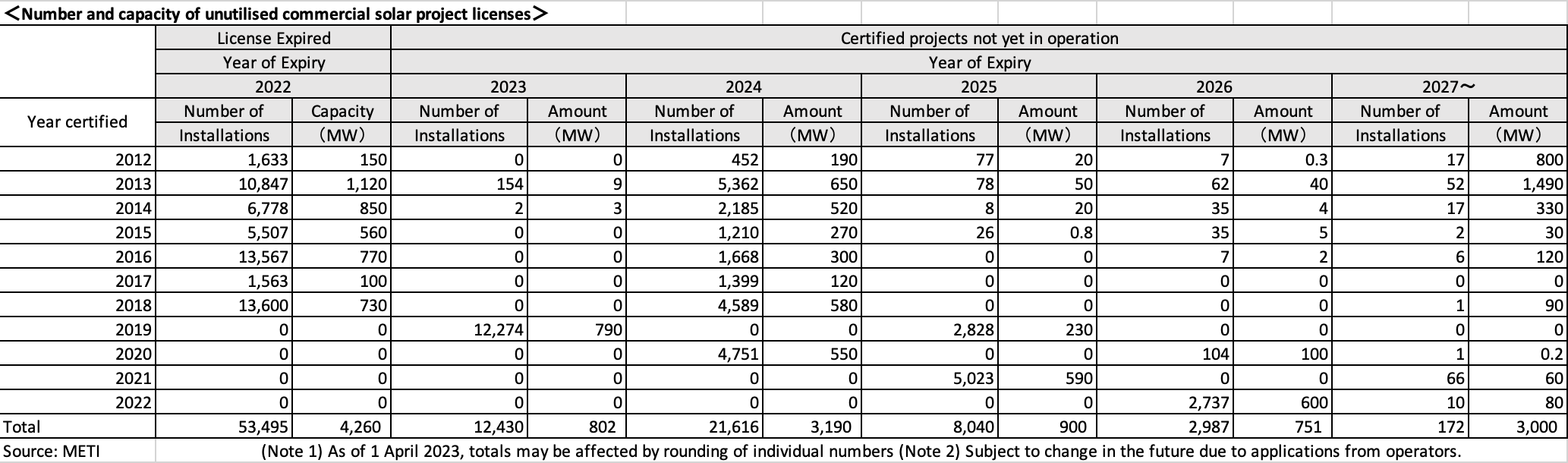
However, about 8.9 GW of capacity certified under FIT or FIP hasn’t been put into operation. Concerned that some license owners are motivated more by speculative reasons or lack the ability to complete proposed projects, METI is canceling licenses when construction has not gone ahead or met other criteria.
The end of March saw the first deadline for proving to the government that a project is genuine; the result has been the culling of more than 53,000 installations with “unutilized” tariff licenses. That affected about 4.26 GW of projected capacity.
This weeding out of inactive license holders will continue. In FY2023, which ends on March 31, 2024, about 12,000 installations for 800 MW of capacity face expiry unless progress is made. In FY2024, about 21,000 facilities with a capacity of 3.2 GW will be in the same situation.
So far, non-tariff capacity additions are small. In FY2022, only about 0.5 GW of solar generation was brought online without utilizing the FIT or FIP system.
Wrong and right agriculture
There are a number of reasons why some developers have not moved forward with construction or met the deadlines set in its application for the FIT or FIP license. As METI’s own expert panels concluded, issues include the ability to secure appropriate land and finding a way to coexist with local communities, as well as an ability to keep costs in check.
One area that seems to have led to several license revocations are projects that combine solar with agriculture (called agrisolar or agrivoltaics). At the end of each quarter, the Agency for Natural Resources and Energy (ANRE) began announcing the revocation of FIT-approved business licenses. In January, one project was revoked for installing facilities without obtaining permission under the Agricultural Land Act. In April, five cases were revoked.
To make sure agrisolar is done the right way, some large domestic companies are joining the sector to develop and test new technologies. With new land for solar at a premium, and plenty of abandoned farmland nationwide, this is seen as a profitable direction both by agricultural equipment makers like Kubota and large energy firms such as oil refiner Idemitsu Kosan, which has a demonstration project for new agrisolar in paddy fields in Kisarazu City, Chiba Prefecture.
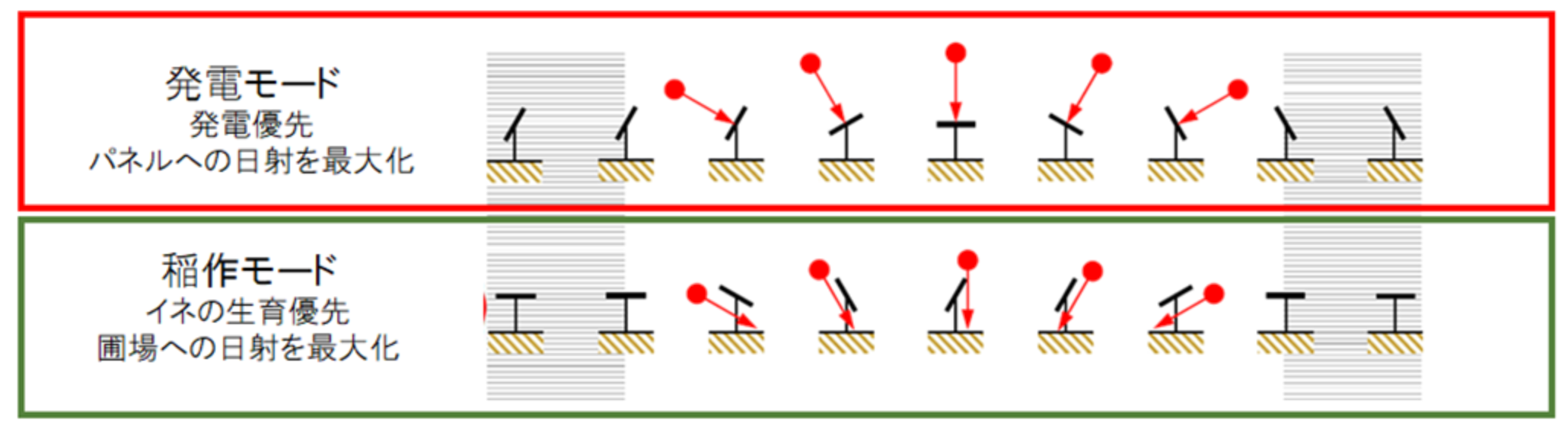
Idemitsu is testing a system that uses a tracking frame which automatically adjusts the direction of panels to follow the movement of the sun; the panels receive light on both sides. The most distinctive feature is that during the rice farming season (April to August), priority is given to irradiating crops grown under the panels in order to maintain and improve yield and quality. Outside of the growing season, the system gives priority to irradiating the solar panels.
Making these adjustments, the company seeks to show that “farming” and “power generation” are compatible and more profitable than their separate iterations. The tracking solar rack is manufactured by Yokohama-based Clean Energy Japan, which is applying for a patent that would cover the tech’s use to illuminate crops during the rice farming season.
The 45-kW test facility will also examine the cost and efficiency of operations before Idemitsu moves forward to commercial-scale, farm-based solar power generation. The demonstration period will last until September 2025.
Rice accounts for more than half of Japan’s total farmland area.
Idemitsu tests solar panels for agrisolar facilities that accommodate rice cultivation
Source: Idemitsu
Advantages of farmer-operated solar power generation
Since the modules are double-sided, the generation volumes lost to irradiating crops can be compensated for throughout the year. The project’s electricity will be sold to the public through Idemitsu Green Power, a wholly owned retail electricity provider.
An automated agrivoltaic system could bring a number of advantages to farmers. It would open up the potential for farmers to earn income from renting out their land, from electricity sales, all while continuing to operate their existing farms.
Electronic materials maker Nitto Kogyo is taking the green concept further and testing solar sharing using reused panels. It has set up a demonstration facility in Kakegawa City, Shizuoka Prefecture that has a capacity of 49.5 kW, expecting to generate 98 MWh of electricity annually. The power will be sold to an electricity trading platform run by Digital Grid.
A Nitto Kogyo subsidiary is supplying the reused panels, under which the manufacturer’s staff will cultivate olives. The site’s shading rate is about 32%. A Chiba university affiliated venture is helping the company with the cultivation plan, as well as with the required permits, etc.
The solar sector in Japan holds great promise, but addressing the slowing progress of recent solar rollouts and ensuring compliance with local and national regulations are crucial to getting the industry back on track. It will certainly benefit from market entry of new kinds of companies and from showcasing collaborations between energy developers and manufacturers.
In the coming years, the weeding out of tariff holders who fail to progress with their solar projects will continue, enabling the Japanese solar sector to operate more efficiently. By overcoming the challenges and embracing innovative approaches like agrisolar, Japan can enhance its renewable energy portfolio, drive sustainable agricultural practices, and move closer to achieving clean energy goals.
GLOBAL VIEW
BY JOHN VAROLI
Below are some of last week’s most important international energy developments monitored by the Japan NRG team because of their potential to impact energy supply and demand, as well as prices. We see the following as relevant to Japanese and international energy investors.
China/ National grid
China is introducing more flexible power transmission arrangements into its national grid system in order to avoid a repeat of last year’s outages. In response to decreased output from hydropower plants, authorities have “rationally optimized” power transmission between provinces to send more power to the drought-stricken southwest.
Critical raw materials (CRMs)
A report by the Energy Transitions Commission says the global supply-demand gap for metals could be reduced by recycling and using less material. Take lithium: by 2030 global demand is expected to soar 600%, and will be 30% higher than projected supply. With extensive recycling and using less lithium, that gap could narrow to just 10%.
Europe/ Oil refining
After Nigeria removed fuel subsidies, which dramatically lowered the country’s domestic demand, one of Europe’s main markets for gasoline has shrunk, threatening to squeeze EU refiners. North America and West Africa, led by Nigeria, are the top destinations for EU petrol exports; the EU produces more gasoline than it uses.
Indonesia/ Oil and gas
Shell and Chevron’s sale of stakes in major projects to Pertamina, Petronas and Eni will stimulate development, enabling the country to boost flagging output, those companies said. In recent years, oil and gas production in Indonesia has been declining due to depleting reserves. “Our participation underscores the commitment to support Indonesia’s production target of 1mbpd and 12 billion cfpd of gas by 2030,” said the CEO of Petronas.
Pakistan/ LNG
Pakistan LNG Ltd and the Azeri firm, SOCAR, agreed that Azerbaijan will offer 12 low-cost LNG cargoes to Pakistan each year. However, Pakistan won’t be bound to buy the gas. Pakistan has struggled to get new long-term LNG deals since 2022 when faced with a domestic financial crunch and European demand that priced the country out of the market.
Saudi Arabia/ CRMs
Saudi Arabia launched its first foray into the global mining industry, taking a minority stake in Vale’s copper and nickel unit. A JV between Saudi Arabian Mining Co and the country’s Public Investment Fund will own 10%. Over the next decade, Vale will deploy up to $30 billion on new projects across Brazil, Canada and Indonesia to expand production of copper and nickel which are needed in EVs.
Uganda/ Oil
Despite opposition from environmentalists, France’s TotalEnergies began commercial drilling at its Tilenga petroleum project in Uganda’s west ahead of an expected start of oil production in the African country in 2025.
UK/ Battery storage
Energy infrastructure development company Carlton Power plans to build the world’s largest battery energy storage (1 GW). Construction of the £750 million battery storage begins in Q1 of 2024 and commercial operation in Q4 of 2025.
UK/ Clean energy
Octopus Energy will invest £15 billion into offshore wind by 2030. The company has $7.7 billion worth of clean energy projects globally. The new investment will generate 12 GW of renewable electricity per year. The company is looking at renewables projects globally but maintains a focus on Europe.
Wind power
The Global Wind Energy Council said a record 680 GW of wind energy capacity will be installed by 2027. Financing has been a challenge; higher energy prices have fuelled inflation and interest rates. But the expected revenues of those who plan to build wind turbines have not risen.
2023 EVENTS CALENDAR
A selection of domestic and international events we believe will have an impact on Japanese energy
ASEAN-Japan summit to mark 50 years of cooperation
Last market trading day (December 30)
Disclaimer
This communication has been prepared for information purposes only, is confidential and may be legally privileged. This is a subscription-only service and is directed at those who have expressly asked K.K. Yuri Group or one of its representatives to be added to the mailing list. This document may not be onwardly circulated or reproduced without prior written consent from Yuri Group, which retains all copyright to the content of this report.
Yuri Group is not registered as an investment advisor in any jurisdiction. Our research and all the content express our opinions, which are generally based on available public information, field studies and own analysis. Content is limited to general comment upon general political, economic and market issues, asset classes and types of investments. The report and all of its content does not constitute a recommendation or solicitation to buy, sell, subscribe for or underwrite any product or physical commodity, or a financial instrument.
The information contained in this report is obtained from sources believed to be reliable and in good faith. No representation or warranty is made that it is accurate or complete. Opinions and views expressed are subject to change without notice, as are prices and availability, which are indicative only. There is no obligation to notify recipients of any changes to this data or to do so in the future. No responsibility is accepted for the use of or reliance on the information provided. In no circumstances will Yuri Group be liable for any indirect or direct loss, or consequential loss or damages arising from the use of, any inability to use, or any inaccuracy in the information.